PicoCTF: Tap into Hash
A step-by-step solution for the PicoCTF Tap into Hash challenge.

Today, we’re diving into the picoCTF challenge: Tap into Hash 2025. Let’s break it down step by step and decrypt the given ciphertext.
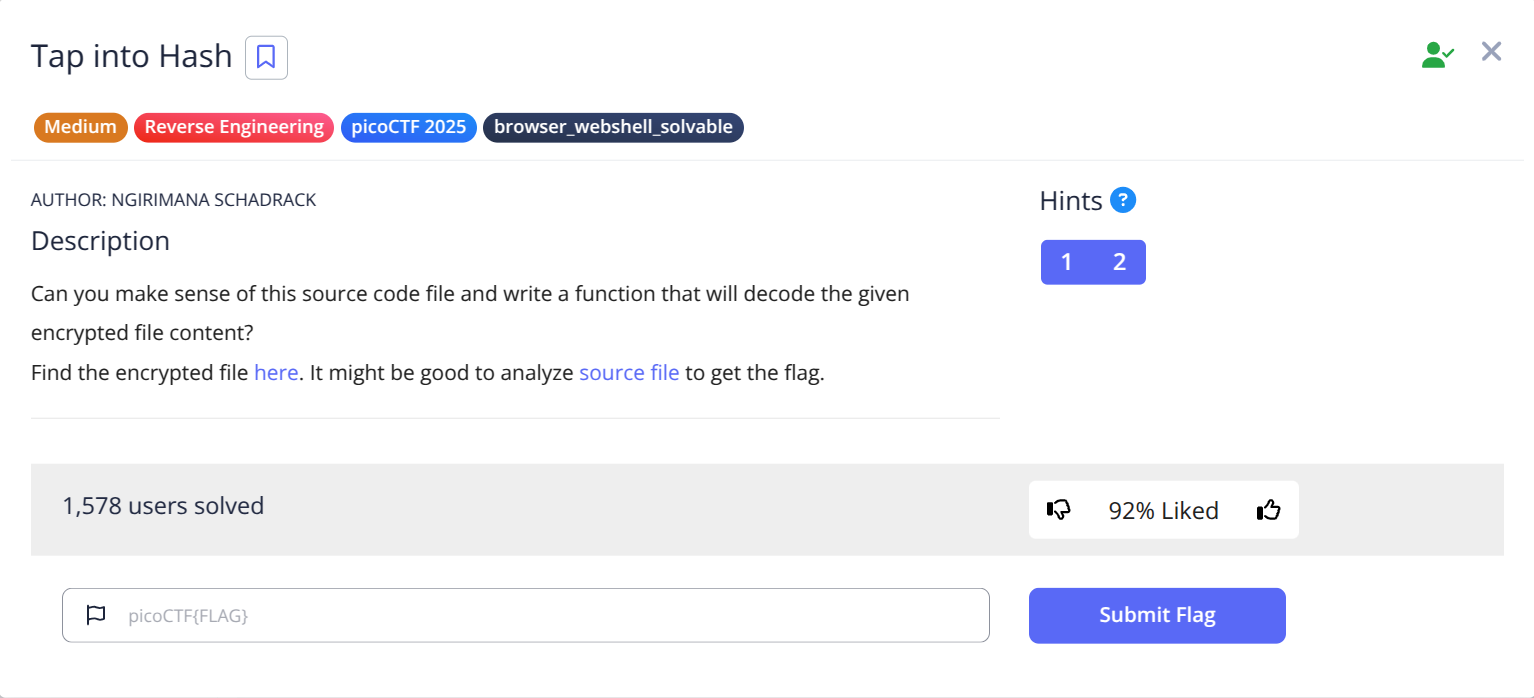
📊 Challenge Overview
The provided Python script accepts an argument and runs a main function that displays the encrypted string. Before writing a decryption function, let’s first analyze how the encryption process works.
🔑 Solution
Breaking Down the Encryption Function
The encrypt function takes three parameters:
plaintext: The original messageinner_txt: A string inserted in betweenkey: The encryption key
Encryption Process
Splitting the Plaintext: the function finds the midpoint of plaintext, splits it into first and second, then inserts
inner_txtin between.Padding the Text: the modified plaintext is processed in 16-byte blocks. If it’s shorter, padding is added.
Hashing the Key: the key is hashed using SHA-256 to ensure a fixed length.
XOR Encryption: the function iterates over the plaintext in 16-byte blocks and XORs each block with
key_hash.The result is stored in ciphertext.
1
2
3
4
5
6
7
8
9
10
11
12
13
14
15
16
17
18
def encrypt(plaintext, inner_txt, key):
    midpoint = len(plaintext) // 2

    first_part = plaintext[:midpoint]
    second_part = plaintext[midpoint:]
    modified_plaintext = first_part + inner_txt + second_part
    block_size = 16
    plaintext = pad(modified_plaintext, block_size)
    key_hash = hashlib.sha256(key).digest()

    ciphertext = b''

    for i in range(0, len(plaintext), block_size):
        block = plaintext[i:i + block_size]
        cipher_block = xor_bytes(block, key_hash)
        ciphertext += cipher_block

    return ciphertext
Decrypt function
Since the encryption method is XOR-based, decryption is straightforward:
- XOR the encrypted string with the same key → This will recover the plaintext.
1
2
3
4
5
6
7
8
9
10
11
12
13
14
15
16
17
18
19
20
21
22
23
24
25
26
27
28
29
30
31
32
33
34
35
36
37
38
39
import ast
import re

def decrypt(plaintext, key):
    block_size = 16
    key_hash = hashlib.sha256(key).digest()

    ciphertext = b''

    for i in range(0, len(plaintext), block_size):
        block = plaintext[i:i + block_size]
        cipher_block = xor_bytes(block, key_hash)
        ciphertext += cipher_block

    return ciphertext

def main(token):

    with open(token, "r") as file:
        data = {}
        for line in file:
            if ":" in line:
                key, value = line.split(":", 1)
                key = key.strip()
                value = value.strip()
                try:
                    data[key] = ast.literal_eval(value)
                except (SyntaxError, ValueError):
                    data[key] = value

    plain_text = decrypt(data['Encrypted Blockchain'], data['Key'])

    pattern = r"picoCTF\{.*?\}"

    match = re.search(pattern, str(plain_text))
    if match:
        print(match.group())
    else:
        print("No picoCTF flag found.")
1
 python block_chain.py enc_flag
🚩 Flag Capture
1
picoCTF{block_3SRhViRbT1qcX_XUjM0r49cH_qCzmJZzBK_8bb7bc38}